



Great foundation for future games.
Like many, Nintendo’s collaborations with Koei Tecmo was a gateway drug for Musou games. For the uninitiated, Musou games are a genre whose origins stem from Koei Tecmo’s long-standing Dynasty Warriors series. These hack-and-slash games based on Romance of the Three Kingdoms typically had you inhabiting one of the warlords of the time, taking on wave-after-wave of soldiers while capturing bases and defeating opposing warlords. The series stood as an ongoing curiosity of mine. The epic scale born from how many people can fit on one screen at a time was alluring but the action has always felt flat. Combat was a one-note experience - slash and slash waves of enemies then move on to the next spot on the map. There was no nuance in attacks, no heft to the weapons, and the cast of characters always felt stuffy. The Hyrule Warriors offshoot solved some of those problems - playing a party of well established, beloved characters with a semblance of original story that kept the player invested in the outcome. So what happens when Koei Tecmo, not mandated by others’ IP, takes a stab at personalizing its series?
Dynasty Warriors: Origins removes itself from the shackles of cross-collaboration but wants to tell a unique story within the three kingdoms world. You play the nameless protagonist (defaulted as and henceforth referred to as “Wanderer”) who predictably lost his memory but gets wrapped up in the exploits of a volunteer army after proving his worth in battle. Wanderer is a silent character beyond occasional response dialogues, meant to be a self-insert for the player. He’s surrounded by a party that has the plucky attitude one might expect from a lighthearted anime. The team finds themselves in league with others in an effort to take down a faction of dissenters called the Yellow Turbans. The tale is workmanlike - there’s some mysteries to unravel with Wanderer’s past alongside the macro story being told, but it’s there to provide just enough personal stakes to keep me interested.
The hack-and-slash action fits like a glove. Missions take place on a limited map space with various factions of armies going toe-to-toe with each other. There’s usually bases strewn about which generals will jockey for ownership of while Wanderer supports in combating enemy forces or works with them to retain control of, the ultimate goal being wiping out those forces and their corresponding generals. In the midst of war you’ll be traveling from base-to-base supporting your allies' efforts to secure them in a capture-the-flag style system. The base will have a health meter you whittle down by killing the low-level mobs and taking out generals. Once defeated, your ranks will occupy that space and you can move on to the next one. The maps are scripted in ways that give them a natural ebb and flow. In some matches there’ll be enemy reinforcements that force you to double back and re-defend spaces. In others there’ll be side objectives like not allowing certain generals in your forces to retreat, others require special abilities you gain to suss-out sources of protection before being able to dispose of enemies. This facet of the game will be familiar to anyone who has dipped their toes into the series before.
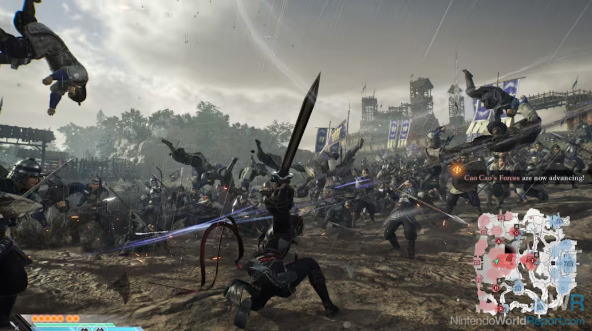
In the micro, hand-to-hand combat is more robust than I remember from prior entries. The prototypical low attack, high attack, block/parry, dodge inputs are all there. There’s a radial dial that lets you select between four special attacks that can be done after defeating so many enemies. These can be charged attacks, area-of-effect, and counter attacks, for example. Then there’s the Mouso attack, a huge sweeping area attack that will toss opponents like that opening scene in Lord of the Rings where Sauron is swinging a mace and swatting people like flies. But it’s how combat feels that puts this one a step above the rest. Different weapons have different senses of weight. You start with a sword and spear, but get additional weapons along the way that feel like distinct tools. The generals have patterns to learn and counter, whereas before I almost never considered the need to time sword swings, hit a counter, then pull off finishing blows. It’s a game of crowd control - peeling back layers of foot soldiers, dividing and conquering generals, and avoiding getting overwhelmed. It feels good, better than I remember other entries in the series being.
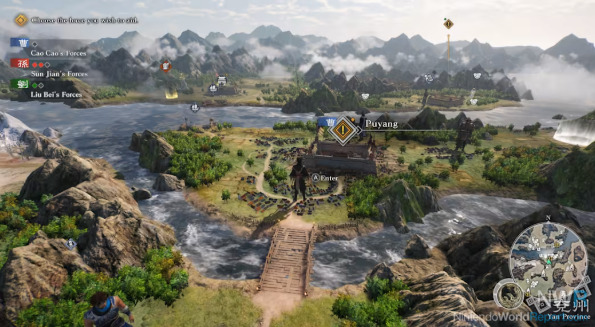
In between battles, you’ll travel across an overworld map strewn with towns, shops, and inns where you can buy weapons, change outfits, read letters, and some other configuration settings. Some of your generals will appear in the overworld, either to chat or provide additional side objectives. These could include things like killing 100 soldiers with a sword, or conquering three bases. Completing those gives experience and upgrades that can be spent via upgrade trees, with benefits like increasing strength/defense, increasing the number of buns (health regeneration items) you can hold in battle, and more. Using the different weapons improves your competency, increasing the offensive moves available and other attributes. There are also side missions that crop up, which are mostly mini battles with objectives like capturing a number of bases or defeating a number of generals. They end up being a little redundant, but they’re short enough to not be a bother as an optional quest, and more than helpful with their frequency if you’re feeling underpowered.
If you’re concerned about how well the Switch 2 runs when stacked up against its contemporaries, be assured that it runs well. In docked mode on default settings, it ran smooth, felt snappy, and while the graphics won’t blow you away, the game looked very nice. In handheld, while it lost a bit of crispness, the graphics still held up well, and the action didn’t get affected meaningfully, though I did notice it ran a little more slowly than in docked mode. There are some settings you can tweak for performance vs. visual quality, but generally I opted for performance. Nothing more important than consistency for this kind of game in my book.
Dynasty Warriors: Origins won’t be a sweeping epic story that lifts you off your feet. Frankly, you probably won’t remember much of its characters and story. It’s not going to be the best playing hack-and-slash experience ever. It’s a little more forgiving than some of its contemporaries, and you'll feel its looseness in the one-on-one skirmishes with generals. That said, Dynasty Warriors: Origins is a load of fun. The dynamic warfare, the tried-and-true grand combat, and substantially improved hand-to-hand combat made this the best Dynasty Warriors game without a Nintendo property carrying it on its shoulders. Dynasty Warriors: Origins will


