



A game of the year no matter the year.
It would be impossible for me to convincingly feign objectivity on the topic of The Legend of Zelda: Ocarina of Time. Like so many, this was among the most influential titles of my childhood. It was my first Zelda game. It was a game that my younger brother and I obsessed over. We used to run around the backyard with our dad’s Mini DV camera reenacting the entire plot to Ocarina of Time as a home movie. We imported the soundtrack, and the symphonic arranged soundtrack, and the club remixes. This expanded to the rest of the series, the animated Legend of Zelda cartoon series, and the choose your own adventure books. The Legend of Zelda: Ocarina of Time is an impossibly important game to me just like it is for many of you. So while no review is ever some sort of objective math problem, this one isn’t even going to come close.
At the time of its original launch, Ocarina of Time served as the origin for the entire series up to that point. It played out (loosely) the events described in the prologue of A Link to the Past, which had itself been set up as a prologue to the original two NES games. Yes, even back then we had a timeline. Just like back then, this makes Ocarina of Time a natural entry point for the series, as it more clearly than most other games in the franchise lays out the nature of Hyrule and its inhabitants. As Link, you set out from a village of forest children to meet with Princess Zelda, and attempt to stop the machinations of the prince of thieves, Ganondorf. Along the way Link will gain access to the titular Ocarina of Time, allowing him to learn songs that convey magical effects on the world around him. I won’t go too deep into the specifics of the story as surely some of those reading may not have played the original. But I will say that the story has never been better told than it is here. Character motivations have been fleshed out, cutscenes have been added for what were previously offscreen events, and even the most random side character has been given meaningful dialogue should you choose to seek it out. I was surprised by how attached I became to characters whose arcs had largely drifted past me in the original game. Midoh, a character who bullies Link early in the adventure, goes through the same character growth he always has, but his improved writing caused me to connect with him in a way I never have before.
For those coming from Breath of the Wild and Tears of the Kingdom, the most obvious hurtle here will be the more gated and structured progression that Ocarina of Time presents. Like the majority of the series prior to Breath of the Wild, this is a game about finding items, and using those items to open paths to yet more items. The pacing and narrative structure of Ocarina of Time remains excellent to this day. It is a game that never gets bogged down in fetch quests, and at all times constantly feels like it is on the move towards the next thing. The balance between overworld exploration and diving into dungeons is very well handled and that hasn’t changed here. At the same time, this remake is seemingly aware of its new audience and makes a lot of subtle accommodations to open Ocarina of Time up somewhat from its linear origins.
As you enter the second act of the story, Link will be presented with several dungeons he’ll need to venture into. In the original Nintendo 64 version, while you weren’t overtly told what order to do them in, you were gated from progression in all but one direction by what items you found along the way. Technically it was possible to enter a dungeon, get the key item from the dungeon, and leave to do something else without actually finishing it, but the intended order was clear. In this new version, while those item-based progress gates are still in place, many of them have had multiple solutions added, allowing you to progress with any one of a variety of items, instead of a specific one. For example, in the original game there was a certain type of switch that could only be activated by shooting it with an arrow. In the remake these switches can also be activated by hitting them with the hookshot. Little changes like this are everywhere. The gates are very much still there, this isn’t the wide-open sandbox of Breath of the Wild, but it allows the player more options and creativity in how they progress through the story. It's a method I hope to see the Zelda team employ to great effect in the future as they strive to balance between traditional and open-world Zelda formulas.
Visually this remake is quite possibly the most impressive first party Switch 2 game we’ve yet seen. Coming in a year that also included Velan’s Star Fox, that was already a high bar. But every frame of Ocarina of Time truly feels screenshot worthy. There is just an absurd amount of rich and intentional detail. From artistic touches such as the subtle cascading waterways of Kakariko village, to the technical details of ground fog reacting to every swinging sword, it is impossible not to stop and stare at this decadent interpretation of Hyrule. But those graphical details also serve the story as completely reworked (and occasionally entirely new) cutscenes carry an emotional weight unlike anything in the original. The story presentation here stands among the best of the series if not at the very top. Much the same praise can be heaped on the audio. From arrangements of the original soundtrack to brand new pieces that weave in seamlessly, Ocarina of Time has never sounded better. I particularly like how the themes of each of the sages make use of their associated dungeon’s Ocarina song. Matt Mercer, who previously voiced Tear’s of the Kingdom’s incarnation of Ganondorf returns to the role, balancing well between campy and truly evil. I really hope we get a chance to one day hear Mercer’s Ganondorf deliver some of the later dialogue in Wind Waker and Twilight Princess. I’m desperate to hear his take on an older, wiser Ganondorf. But the cast doesn’t stop there. Navi, voiced by Lisa Reimold, reinvents the character thanks to some great writing which allows her to serve as a sort of proxy voice for the silent Link.
In the decades since its original release, Ocarina of Time has undergone plenty of retroactive scrutiny. Arguments have been made that later games in the series have done much of what Ocarina of Time did but better. What this remake has done, despite all its fresh touches, is remind me just how incredible that original underlying game remains to this day. From its world that so perfectly balances between exploration and dungeons, to its puzzles that never get too esoteric while also allowing you the freedom to solve them yourself, this is a refined gem that has only been polished even brighter. Its story has been reinvigorated while still conveying its original themes of being forced to reckon with the changes brought on by time. Over the years I’ve played and replayed Ocarina of Time across Nintendo 64, Gamecube, Wii, 3DS, and Wii U. And yet this version was the first time since playing it as a kid that I was truly wrapped up once again in this world. I talked to everyone, I played every minigame, and kept fishing at Lake Hylia long after I had gotten every reward the game had to offer. This is an incredible telling of one of gaming’s best stories. It's an incredible arrangement of some of gaming's best music. It’s one of the most visually impressive games Nintendo has ever made. This is the best way to play one of the best games ever made.
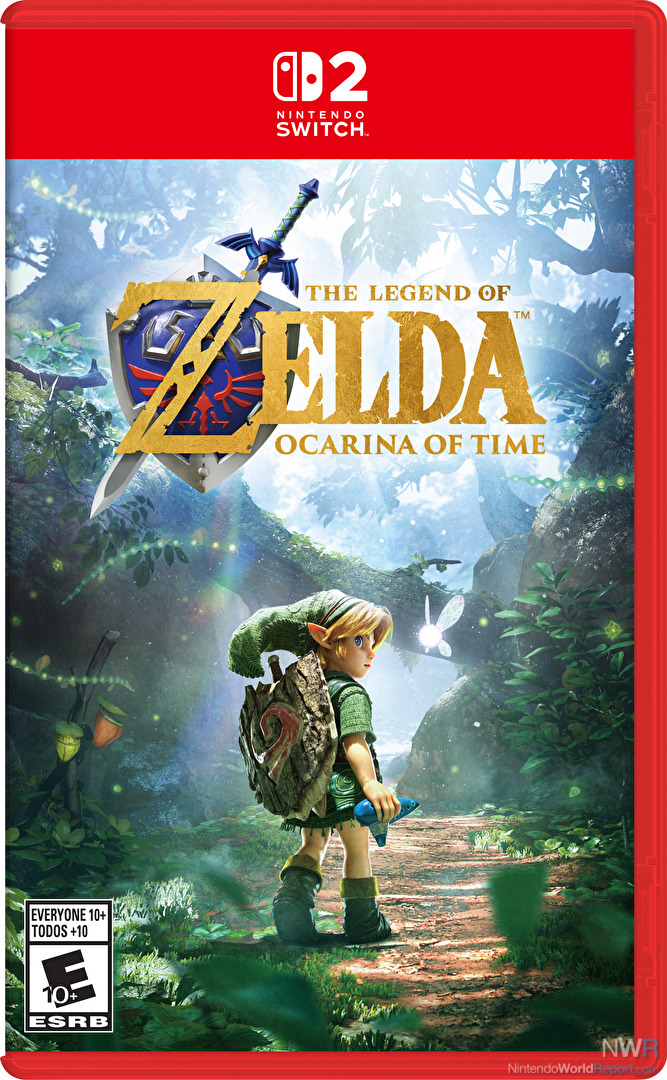
 Zelda no Densetsu: Toki no Ocarina
 The Legend of Zelda: Ocarina of Time
 The Legend of Zelda: Ocarina of Time


