I am a single issue voter, and that issue is that the game is too damn long.
http://www.nintendoworldreport.com/review/78186/fire-emblem-fortunes-weave-switch-2-review
Fire Emblem: Three Houses elected to not have a “golden ending” for two reasons: the game’s house choice was so central to the story they didn’t want to alienate people who preferred one house over the other, and the realization that even on Normal+Casual difficulty it would take upwards of 200 hours to do them all if you were lucky. Its ostensible successor, Fire Emblem: Fortune’s Weave, has abandoned all pretense and not-so-subtly encourages the player to spend enough time working through four different stories that it makes successful live service games look like Mario 1 speedruns. On the last map I played before starting this review, I triggered an in-game achievement for having 80 hours on my save file and I wouldn’t even say I’m halfway through the first part of the game. In short, Fortune’s Weave may not be the best game of the year, but for Switch 2 it’s definitely the MOST game of the year.
The framing device for the game is simple. The continent of Dagda, located to the south of the Fodlan continent of Three Houses, has fallen due to the release of the god of the underworld. The “progenitor god” Sothis has directed some of the few surviving humans on the continent to create an avatar to lead a small army against the underworld god’s forces. After what is intended to be an unbeatable battle against a possessed god, the army retreats and finds statues of eight “Flame Lords” who proved themselves in the Dagdan Heroic Games a few years before. The Flame Lords have all died, and so the avatar takes the form of a bird and has to travel back in time to the year of the Games in order to ensure their survival by any means necessary. Although the avatar options are simple, this isn’t a Xenoblade X system; even if it ends up taking cues from it, it’s pretty extensive for Fire Emblem. There are two body types which present male and female, a few options for hair styles, and plenty of options for color if you’d like to get the blue-haired lord out of the way early. Fortune’s Weave is also the first Fire Emblem I can recall that offers an arachnophobia mode, giving the option to change certain enemy appearances at the time of avatar creation and again in the menu during the game.
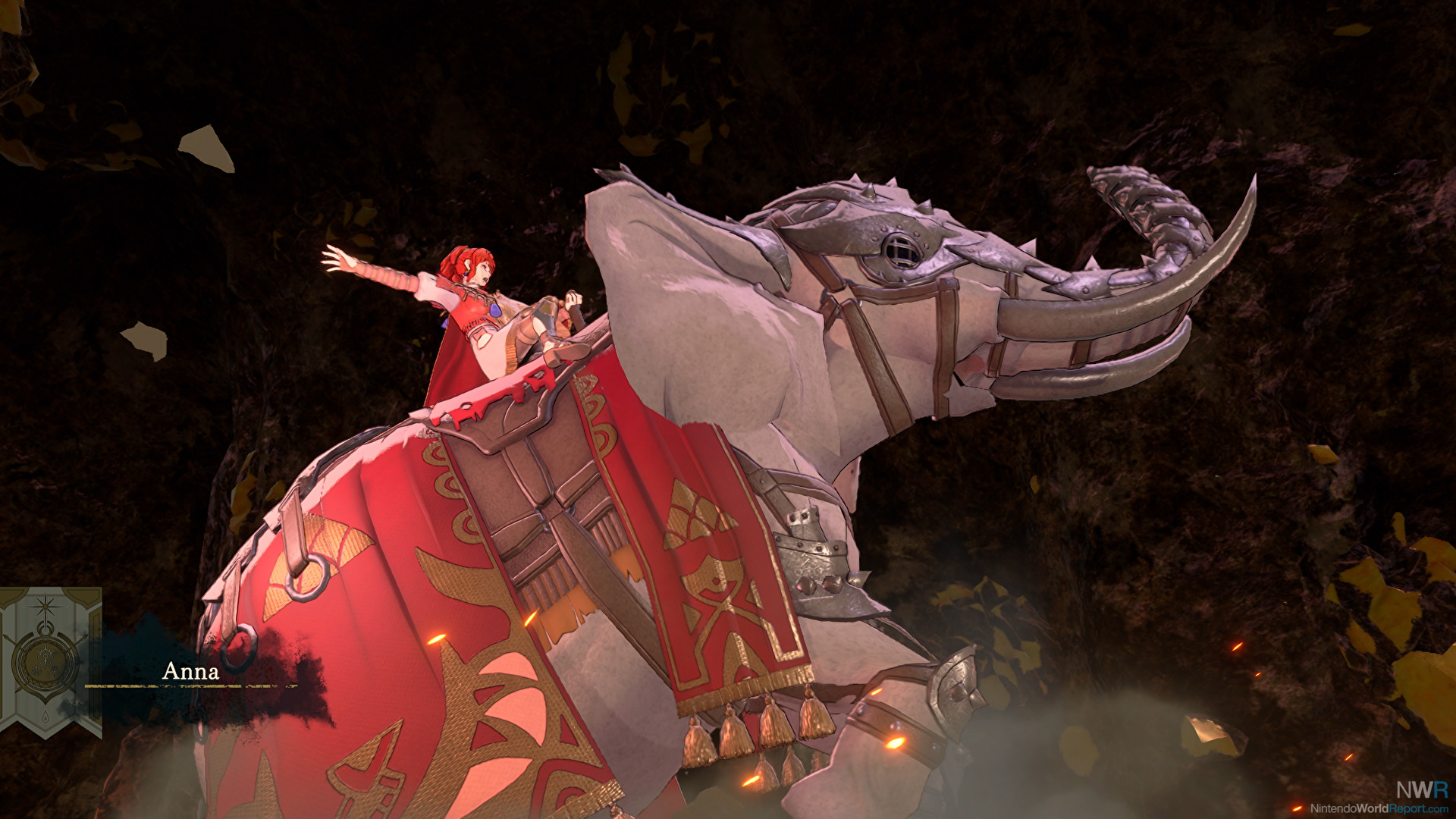 All pretense was abandoned when the Fire Emblem queen of capitalism was mounted on an elephant.
After the seemingly impossible map that was beaten within 36 hours of the game’s September launch with just three characters, the avatar moves into an area with several obelisks and has to pick from one of what begins as four but will likely expand to eight options once the final part of the game’s Expansion Pass launches in 2027. A character is not considered to be safe for the endgame until after 18 story chapters are completed, 12 of which are considered “part 1” and are broken into three chapters before arriving in the Rome-inspired central city of Dagsion and then nine chapters that take place over a year period in Dagsion centered on the Heroic Games. The other six chapters make up “part 2” of the story and are more traditional base -> battle sequences centered on fighting off an invasion of a neighboring state; unless you’re playing the leader of that neighboring state Theodora, the path character largely becomes a third wheel at that point. Once complete, the game encourages picking another path and repeating the process to see them through the Games and war until all available characters are safe. It’s this repetition that leads into the game lasting as long as it does: parts 1 and 2 combined even on the lowest difficulty level take anywhere from 40 - 50 hours to complete unless a LOT of time is skipped in Dagsion once the option is available.
A typical chapter from 4 - 12 usually plays out as follows: a cutscene reveals what the boss of the chapter is, whether it’s a match in the Heroic Games or some sort of boss on the world map. This is done in Dagsion, and then a number of “turns” ranging between 20 and 160 is provided with each turn lasting six in-game hours for four turns a day. At this point, you can move about the city and talk to characters, purchase items / weapons / gifts for character recruitment, build skills and build support with other characters toward character recruitment - each person having different support level and “renown” requirements, the latter generally increasing by completing story and path quests. The requirements change from character to character; it’s a lot easier for the attractive swordsman Dietrich to recruit people than it is for the 15 year old walking war crime Cai. Sidequests are offered in Dagsion as well, in various combinations of path-specific ones and common ones: in a minor miracle, the common quests are automatically completed and the rewards provided as they would be unlocked in later paths. The character specific quests in the first part eventually lead to unlocking powerful classes for use starting around chapter 12 of a typical playthrough.
I chose Leda’s path first because of a personal preference for vengeance-seeking performers and to get a theoretical refresher online as soon as possible. Leda as a character hits a lot of the same notes as Primrose from the first Octopath Traveler as a performer who is out to take revenge on the people who killed her father, but the Seven Year Rule applies to video games as much as it does to professional wrestling and comic books. And it gets the obligatory dead father in a Fire Emblem out of the way early. As it turns out, Leda’s is actually a good path to start with because her path-specific quest involves travelling to all corners of the continent to perform as a dancer so I unlocked a lot of locations that paid off in the next run. There was a good variety of map styles in this path, including a combat form of Othello / Reversi that brought back the concept of Phoenix mode from Fire Emblem Fates but as a one-off map change and setting the fallen character back in the starting position with a one turn penalty.
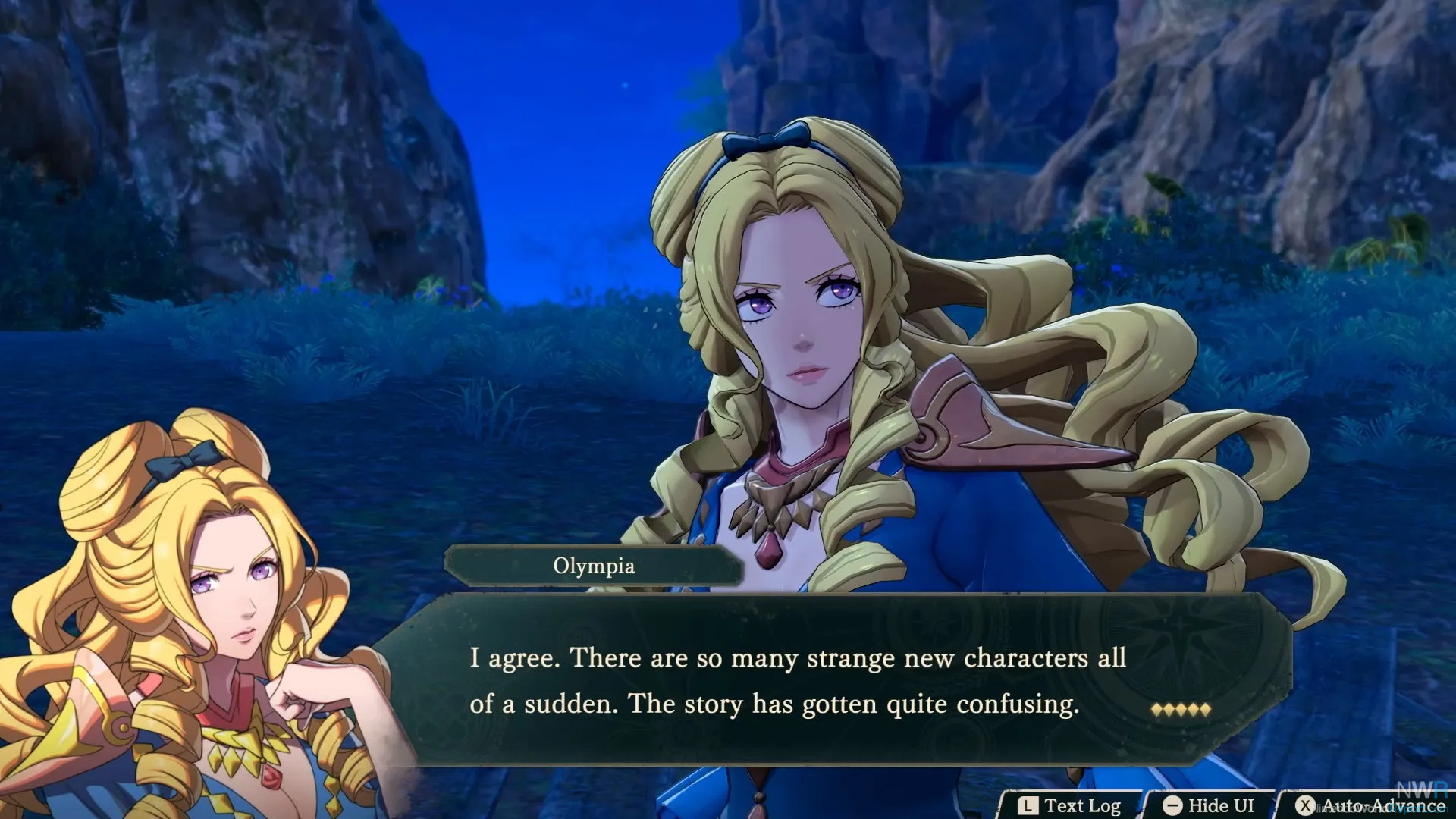 I don't know who at Treehouse got this line into the game, but they knew.
Dietrich’s path was my second and I would recommend it to two groups of people: people who love Fire Emblem combat, and people who got way too into the lore of Three Houses. The two main characters of the path are both native to Fodlan, there are a couple of cameo appearances from minor Three Houses characters, and it’s the only route that reveals something about a major part II villain that I’ve found. Dietrich’s personal quests involve going to a location and challenging someone to a 1v1 fight which unlocks new battle techniques which you can enhance or give to other characters since they involve weapons he may not be good with. He also has access to every “paralogue” side story barring his own, the only character so far with that option, and so he often ends up hilariously overleveled compared to the rest of the army: as of the time of writing this review he’s seven levels higher than everyone else I have access to. Each path has special character interactions and unfortunately, Dietrich’s is the most annoying set since there’s one scene that if you miss a scene a full five chapters earlier you lose it. Although you can time jump back to the chapter to see the first scene, you’d still have to replay five chapters including the two longest ones after that to see the second.
Theodora’s path is the easiest path to recruit on, largely because the armies might have a core four, but she needs to build up a huge army to defend her country in part 2. Her path quests involve delivering large quantities of supplies to locations around the continent, but she’s the only character who has access to the Battalions - special units that can be used once or twice a map for damage or effects as seen in Three Houses - in the first part. Cai’s path is realistically yet annoyingly restricted, since he’s seen as too young to get through to parts of the map even at high renown and he has to focus on gardening and raising horses in the city proper which only serves to add more busywork to the city exploration each week. Which is a shame, as he would be an ideal first route to take if it wasn’t for the confinement you end up having to deal with.
As mentioned, Part 2 borrows a lot of its structure from Engage and pre-Three Houses Fire Emblem: after buying and completing tasks at a base, you jump into a battle map. These maps are the longest you’ll encounter pre-part 3 and are also bookended by a lot of long cutscenes in a game that’s already not lacking for them. It really streamlines the progression, including giving an option to catch every person in the party up to the recommended level who isn’t already there and restoring supplies on every single map. An option is provided to skip this entire part, but given the amount of experience you can get for the party over the course of these chapters this feels like a sucker’s bet more than anything, especially as some of the carryover to other paths is tied to completion of part 2. Part 3 looks to cross a strategy RPG and Cities: Skylines, as you have to build the continent back to the point of being livable again while doing every character’s path action (delivering supplies, performing, battling, gardening) and fighting off occasional invasions / boss fights.
Unlike previous Fire Emblem games, Fortune’s Weave only has one save file: Three Houses ended up getting patched to have 25 and Engage was there by default. There’s also an aggressive Pokemon Legends: Z-A style autosave, which notably triggers on every attempt to upgrade a character’s class which returns to the “promotion exam” system of Three Houses. Better hope RNG is on your side if you didn’t pick a guaranteed class, because the autosave happens during the trial cutscene so it can’t be save scummed. Though it is nice to see the Michael Grohl Rule first coined for Pokemon - if it's not 100% accurate, it's 50% accurate - doesn't just apply to combat. The class system and levels in Fortune’s Weave are notable for running up to what appears to be six tiers, and character levels are closer to that of a standard JRPG. I had a few characters at the end of part 2 that were in the low level 50s, whereas Fire Emblem traditionally has characters who promote to more powerful classes reset to level 1 and grow from there. Class availability in the first part is typically available based on renown level, which can’t be cheesed - though it is somewhat possible to cheese character recruitment since support levels can be retained if you elect to restart a chapter and that option is always available. Trying to play it straight takes a lot of time, however, and some characters are locked behind the completion of paralogue quests or other requests which can include everything from paying them to finding three rare meat drops from the middle of nowhere.
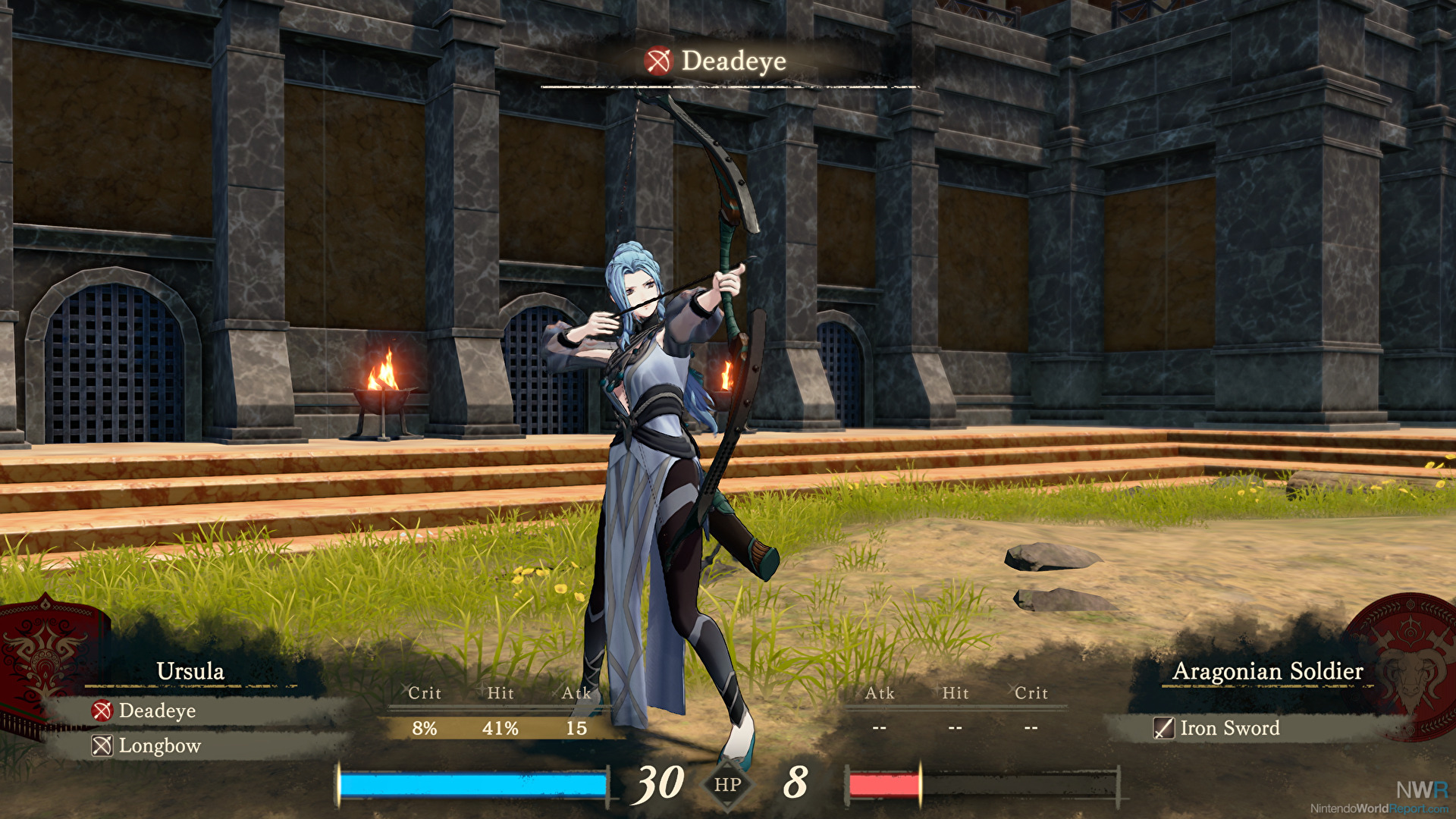 The best Ursula in Fire Emblem history is an example of a character whose recruitment is tied to clearing a paralogue.
Players have only two choices of difficulty in Fortune’s Weave as of press time in Normal or Hard, plus the standard choice of Casual / no permanent death or Classic / permanent death mode: although a third, even harder difficulty could be patched in later, I’m not sure it’s needed. There’s plenty of differences between Normal and Hard difficulty based on comparison with my playthrough and my roommate’s, in addition to the standard unit strength and quantity of reinforcements. (Side note: I have not seen “same turn reinforcements” once, though there have been plenty of unlimited reinforcement maps especially in part 2.) There are seven deities that offer different buffs in combat: one permanently available one that gives the ability to rewind turns and the player picks three of the remaining six. On Normal, time rewind is a free action, and there are costs associated with using the other three. On Hard, the rewind uses the same currency and the costs are higher by default. That said, even on Hard, the goddess Kalla’s abilities which OPEN with +50 to the “Avoid” or evasion stat and cap at a uniform +2 space movement per turn are completely busted. Part 2 ends on an objective of “get [path leader] to the exit”: between Kalla and Dietrich having a signature ability that adds an additional 3 spaces to his movement AND the option to attack or immobilize nearby enemies means that might be a four turn clear if you play it correctly.
About 75% of my playtime with Fortune’s Weave was done playing on TV with a Pro Controller, and after a few hours I got used to the control oddities, except for there being two different buttons that bring up menus in + and X. Most menu functions are under the Start menu, but for inexplicable reasons the list of active quests is only under the X menu and some of the options you’d expect to have in a menu are only accessible from specific places in Dagsion. (Looking at you, support levels.) The game felt like the framerate was consistent both when playing on TV or in Handheld mode, with the only slowdowns meaning someone was about to land a critical hit. Mouse control support is available in combat and worked fine, and the option is present to adjust the mouse sensitivity on the fly.
With a game that offers as many playable characters as Fortune’s Weave, the characters need something to make them stand out, be it by their appearance or performance. Thankfully, the character variety is strong, and there were a few characters I had on Leda’s route that I will go out of my way to grab in later runs: I’ll be able to take the best aspects of them and combine them into a superunit for part 3. Although Dagsion is a huge city with a lot of theoretical variety, I appreciated what I found in the dungeons or just the skirmish maps on the world map a bit more. Thankfully, the end of chapter maps are varied by design. I haven’t noticed any killer tracks on the soundtrack so far, but the voice work in English has been on point the whole time. Credit to the director for that.
Fire Emblem: Three Houses ended up becoming my “short term disability” game in early 2020 even before the world became Dagsion for about a year, and when I finally finished my objectives with it, I had put about 700 hours into the game to unlock the full support log. I don’t think Fortune’s Weave will hit that number unless the final part of the Expansion Pass gives four part 1s as it’s threatening to, but I can already tell this will be the longest “time to credits” game of my life. And I do want to see it through… just not all at once. There’s other things I want to play or have for review, after all.


 Topic: Fire Emblem: Fortune's Weave (Switch 2) Review (Read 68 times)

